
The W198 300SL "Gullwing" and Roadster

Updated: Aug 28

Mercedes never intended to produce the "world's first supercar" with the origins of the W198 held firmly on the racing side of the business, but as development progressed alongside a booming market from post-World-War-II United States, Mercedes-Benz saw potential and began to explore bringing their revolutionary racing car to the streets of everyday America and the world. The first road-going Gullwings were produced in 1954 with the Roadster following in 1957. Just over 3,000 examples of the W198 were built over its 9-year production run ending in 1963.


While you'd expect the first of its kind to be innovative, the engineers of the time truly brought some never-before-seen concepts to the road-going W198 300SL based on its track-only counterpart, the W194. From tube framing to independent suspension to the first gasoline direct fuel injection and even the iconic "gullwing" doors (hence the nickname), Mercedes left no stone unturned, in some cases to the detriment of the vehicle itself, at least when it came to daily driving.


On the iconic side of the coin you have the gullwing doors. While striking in appearance, these actually were a practical solution required by the development of the lightweight tubular spaceframe chassis. The spaceframe provided rigidity while minimizing weight, leading to increased performance and handling. It also had high sills where your typical door would be, leading to the need for upward opening "gullwing" doors. While necessary, iconic and unique, the large sill did make ingress and egress difficult for occupants and also contributed to a somewhat claustrophobic interior, especially considering the windows did not roll down on the coupe (though they could be removed). This was largely rectified by the release of the drop-top Roadster in 1957 though values of the original Gullwing remain higher despite the comfort trade off.


Underneath the vehicle was the innovative suspension including independent double wishbones at the front and an independent swing axle at the rear. This provided agility and stability, better load distribution and reduced unsprung mass in comparison to solid rear axles.

One of the main innovations, and more relevant to Black Forest, was bringing direct injection to a gasoline vehicle. Until that point (and for many years after), vehicles used carburetors to mix air and fuel before reaching the combustion chamber, however, though a trusted technology they were inefficient in both fuel economy and power output and performance was heavily influenced by temperature and atmospheric changes; undesirable for a race car.


Slow response, misfires, low fuel efficiency and limited compression ratios were major problems when it comes to racing so Mercedes-Benz spent countless hours and a small fortune to bring the first gasoline direct fuel injected vehicle to the world. Though theoretically superior this didn't come without problems, mainly stemming from the relatively imprecise mechanical technology of the era.

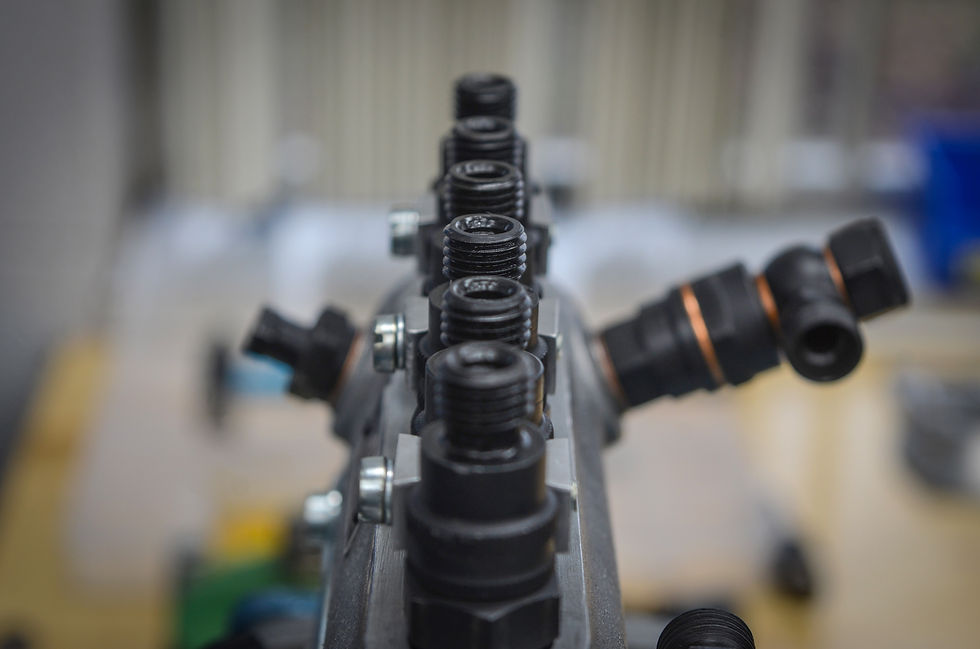

Racing is a great application for direct injection as large amounts of fuel are often needed to accelerate and maintain high speed, but most daily drivers weren't taking their W198 to the track. Idling and low speeds proved difficult for the fuel injection pump to manage leading to rich running and fuel dilution which would cause increased wear and poor engine performance, problems that continue on these vehicles today.


Worse, any wear or damage to the leather diaphragm (which controlled the amount of fuel injected via vacuum and the venturi effect) would exacerbate the rich-running issues and required regular service. Since this was expensive and time-consuming fuel injection pumps were largely ignored and many W198s continue to run rich. Peruse online forums and you'll find countless mechanic myths and tricks suggested in a fruitless attempt to fix these issues, almost always ignoring the main culprit (a worn down, dirty and faulty fuel injection pump).
Though ground-breaking, the fuel injection pumps of the W198 were an evolutionary dead end with Mercedes-Benz reverting back to indirect fuel injection in the W189 300d, though they continued to use and develop fuel injection pumps rather than carburetors. The R9/22 from the 300d would serve as the basis for indirect fuel injection pumps for later models such as the W198 and W121s follow-up, the W113s.

With roots firmly planted in the racing world, it's no wonder that the W198 300SL was a revolution in the performance category, but its influence went far beyond its road-going capabilities, proving that a market existed for high-dollar, high-luxury "supercars". Today nearly every automaker has a supercar or hypercar leading their lineup and auto enthusiasts around the world crowd streets just to glimpse the latest offerings from their favorite brands. Despite this flood of high-performance options, the W198 300SL has not only held its own in the market but has seen value skyrocket, rarely selling for less than $1 million dollars at auction for even rougher examples. Take a look through the gallery below for some more images and details of the W198 300SL.


Check out the art and collectibles page under the "Culture" drop down to see more art and design.


Stay tuned for more as we focus in on the evolution of fuel injection pumps. From the abandoned direct injection of the R2s, R3s and R8s of the 300SL to reverting to indirect fuel injection with the R7 and R9/22 from the 300d, and onto the pumps that would bring Mercedes-Benz to the edge of the electronic age with the R11s, R18s, and R20s of the W113 era, we'll explore how Mercedes-Benz gradually improved mechanical gasoline fuel injection until electronics took over in the 70s and 80s.


Comments